
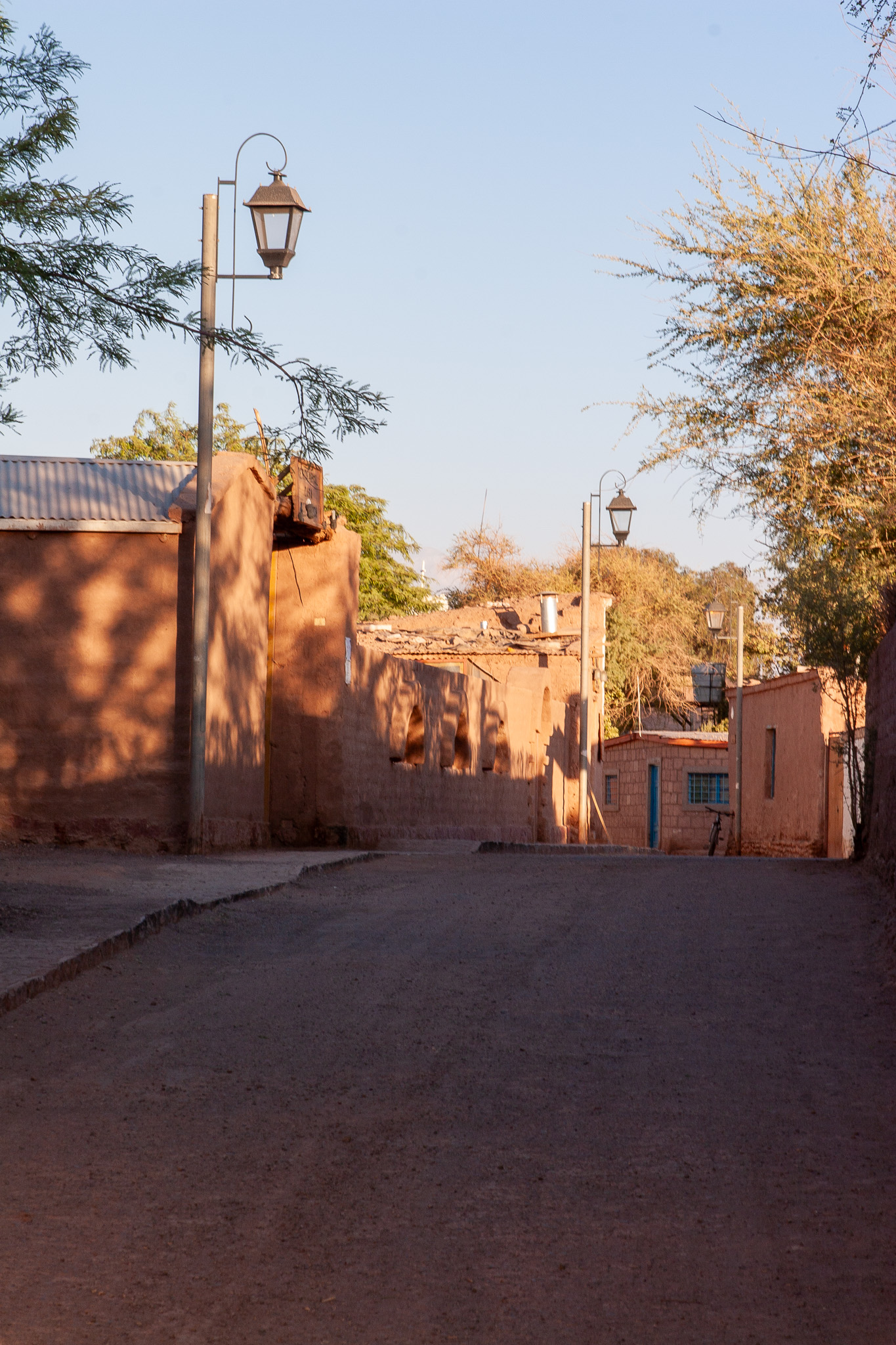
Santiago to Calama, and then the road south-east to San Pedro de Atacama — a village of adobe walls and dust at 2,400 metres, about ten minutes’ walk from one end to the other. Yesterday was Christmas Day in Santiago. So the first thing to do here is walk the village, which takes a little over an hour because the light changes every few minutes and I keep stopping. Ten frames, from the sun still in the trees to the streets lit and everything else dark.

The streets are unsealed. The walls are adobe — whitewashed and capped in places, plain mud in others, with a lamp on a bracket at the corner waiting to come on. Two riders come up the road at a trot with a white pickup behind them, and the dust stays in the air after they have gone. Judging by the drooping foliage, the big trees along the street are pepper trees. They are the only shade in town.


A dog has its head and shoulders inside a rubbish bin set on a timber frame against a white wall. It is still there when I have finished photographing it.


From the top of the street, where the paving gives way to steps, the cone east of the village turns pink. Presumably Licancabur, 5,916 metres, which stands on the Bolivian border and is what everything here gets photographed against. The colour lasts a few minutes and then it doesn’t.
There is a Christmas tree still standing in the square, decorated, inside a low paling fence, next to a thatched shelter. It is the 26th of December.
The shops light before the street does. An artesanía with a lit window and a diamond-shaped sign; then Ayllu, its name in cut wooden letters under a bulb, with a chalkboard by the door offering sandwiches del chef and cerveza fresca. An ayllu is an Andean kin group that holds its land in common — the oldest unit of organisation in this part of the world, put over a bar door.


By the time I reach the main street it is dark, and the whole of it is warm light — doorways, signboards, one man walking down the middle of the road.
Blanco
Blanco is at the end of it — a white lit box set into a dark adobe wall, a curtain inside the doorway, chalkboards on either side. One of them is the menu del día: sopa del día, miso de tofu y verduras, arroz del día, gnocchi de quinoa con salsa tres quesos, postre del día, torta mil hojas. It turns out to be both the first dinner here and the last.

The Hostería
I am at the Hostería San Pedro de Atacama for four nights — low adobe ranges of rooms set round courtyards, gravel underfoot, pepper trees, and a long pool that looks very good in a desert and is the best thing about the place.


It is also never quiet. Not late-at-night noisy in the way a place near a bar is noisy, which you could plan around; noisy at every hour, so that there is no part of the day or night when you can count on the room being still. I have four nights here and an excursion leaving at four in the morning, and I already know how that is going to go.