
Second day at Iguazú and the bird turns up where you would least expect a bird: standing in twenty centimetres of white water at the top of a fall, on wet black rock, entirely unbothered.

It is a black-fronted piping guan — Pipile jacutinga. Dark blue-black body, a scatter of white spots across the wing coverts, a white crest lying back over the crown, bare blue skin on the face and a bright red wattle hanging under the bill. Coral-pink legs. It is roughly the size of a small turkey and it is walking about in the spray as though this were entirely ordinary.

It is not an ordinary bird. The piping guan lives only in the Atlantic Forest of Brazil, Paraguay and Misiones, it depends on palmito and other fruiting trees, and both the forest and the bird have gone in most of the places they used to be. It is listed as globally threatened. Iguazú is one of the few places you can still stand in front of one for as long as it will let you.

The rest of the day
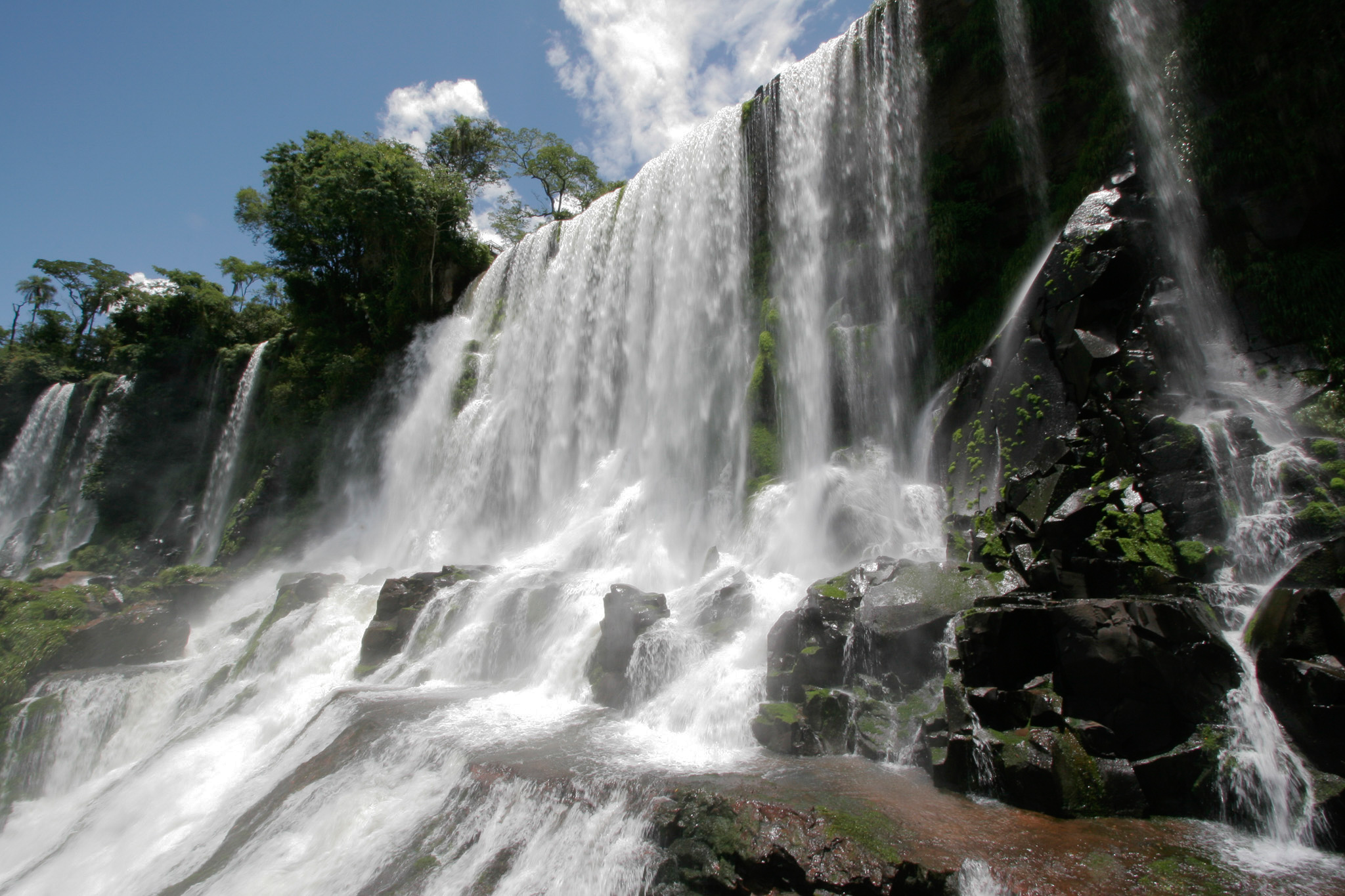
The second day is for the Upper Circuit in good light. From the high walkway the whole line of the falls runs away to the left in a curve, one tier above another, with mist standing over the Garganta del Diablo at the far end and the forest completely unbroken behind. Under one of the drops a walkway carries perhaps twenty people right into the spray, and from below they are small enough to give the fall a scale. A few butterflies, a peregrine falcon and monkeys add to jungle vibe.


The tiered falls in flat afternoon light are the pictures that hold up — black rock, white water, hard green, no sky. The collapsed walkway, destroyed by floods in 1992, is endlessly fascinating.


