
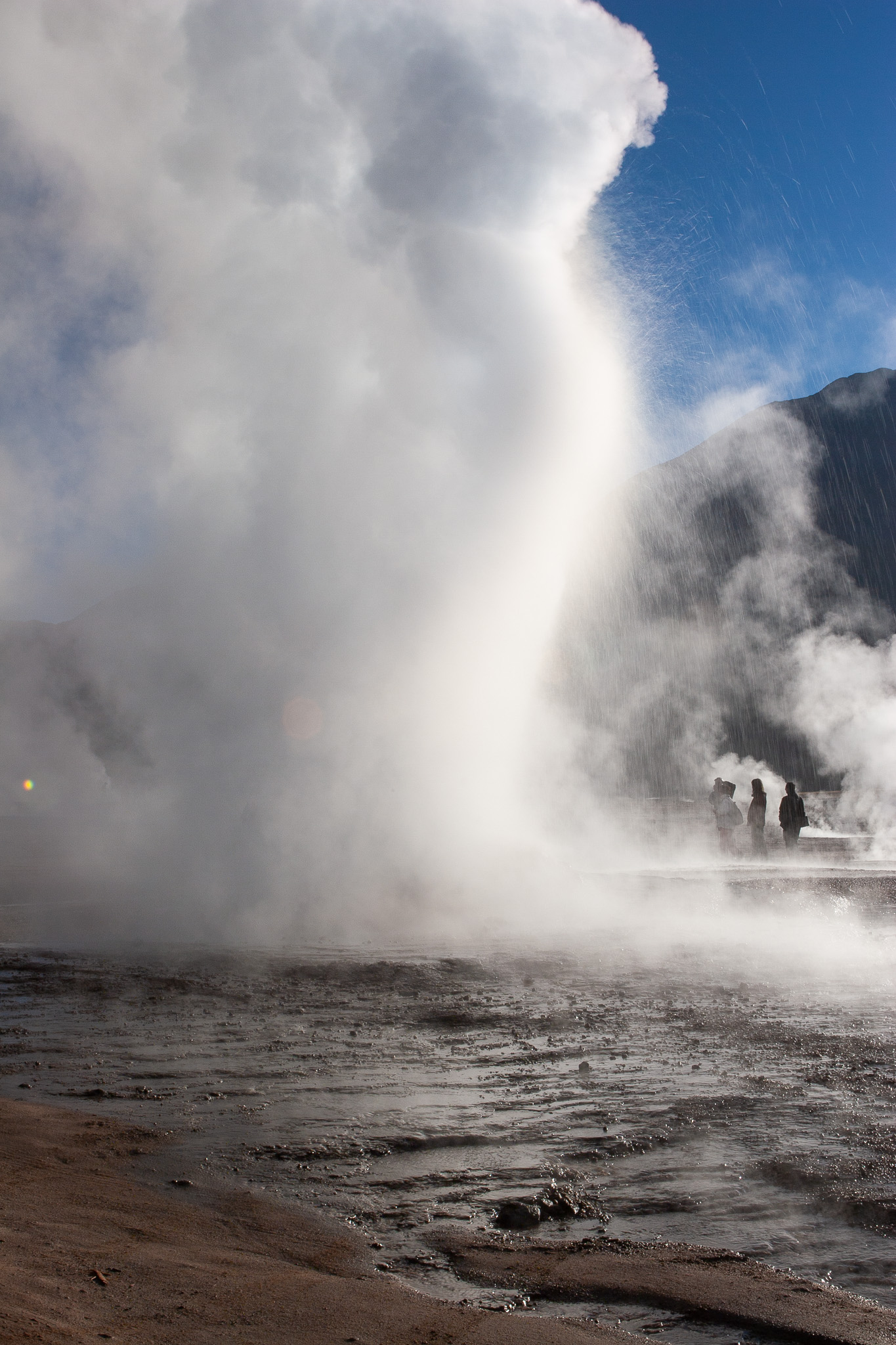
El Tatio has to be done in the dark because the steam only shows properly in the cold. We leave San Pedro de Atacama at something close to four in the morning and drive up. The field sits at about 4,320 metres, which is high enough that the guidance is to move slowly and not to be clever about it.

Getting up at half past three turns out to be no hardship, because the Hostería San Pedro de Atacama has not let me sleep anyway. It does not go quiet at night and it does not go quiet in the small hours either, so I am awake for the alarm and mildly pleased to be leaving the room.
The minibus is a white Mercedes Sprinter, Chilean plates. It stops on the way up with a man crouched at the rear nearside wheel to change a flat tyre and another standing in the road looking at the horizon, and the pause lasts long enough to be worth photographing. Tyre changed. We go on.

What the field looks like
There are more than eighty active fumaroles here and at first light they are all producing at once — columns of steam two and three metres high across a flat brown pan, with a line of people standing among them in silhouette because the sun has not cleared the ridge. Behind, the altiplano goes up in long tan slopes to volcanic cones with old snow in the gullies. An unexpected sighting of a rhea, an ostrich like native bird.


Close up the ground is the better subject. The sinter around the vents is orange and ochre and cream, banded, with black grit where the water has stopped running. Thermophilic algae, presumably, doing what they do in every geothermal field, but here the colours are stronger than anything at Rotorua.


On the way back down we stop at Machuca, a village of perhaps twenty people at 4,000 metres with an adobe church and a thatched roof. The cross on the gable is painted in bands of red, green, yellow and blue, and still can’t compete with the natural saturated colors of the hot water algae.


Back in San Pedro by the middle of the day, with the light gone hard and flat and nothing worth pointing a camera at until the afternoon. Next: the salt mountains west of the village.