
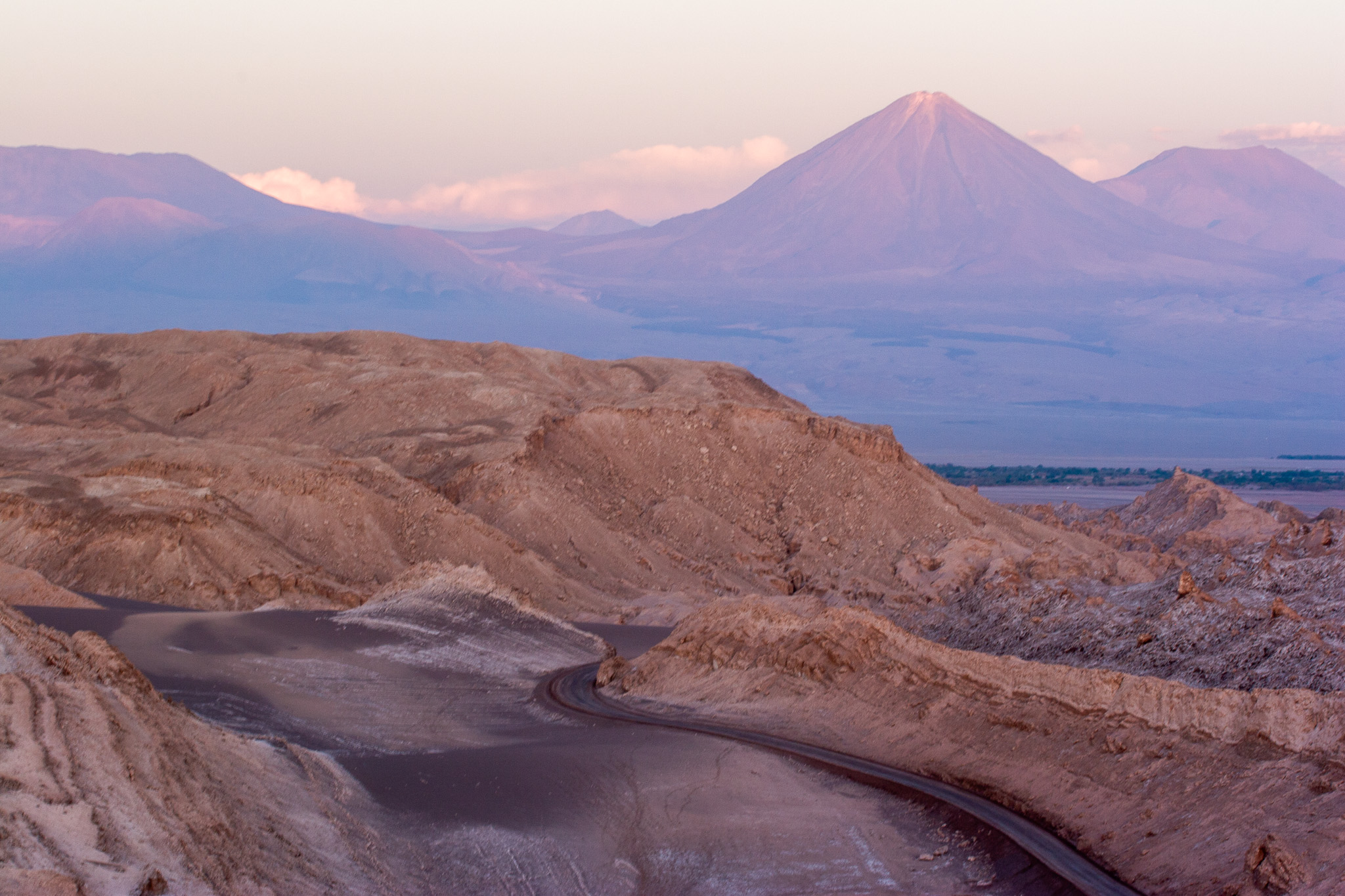
Nothing in the Valle de la Luna is what it looks like. The cliffs are not rock, and the white on the valley floor is not snow. Both of them are salt.

The valley sits about thirteen kilometres west of San Pedro in the Cordillera de la Sal, the Salt Mountains, which are exactly that. This was the floor of a lake. It dried, and left behind alternating beds of salt, gypsum and clay; the Andes then pushed the whole sequence up on edge, and the wind has been taking it apart ever since. What you walk through is a lake bed standing on end.

The formations
The road in runs through a cut with walls three or four times the height of the bus, banded horizontally in cream and rust and grey. Every band is a different hardness, so the whole face weathers into fins and blades and overhangs, and in one place the ridges are so finely dissected that from a distance the hillside reads as fabric rather than stone.


Then the dune. A single enormous ridge of pale sand running up out of the valley floor, with people walking the crest of it in single file and long straight tracks coming down the face where somebody has ridden a board down. Behind it, the best part of fifty kilometres away and 5,900 metres up, Licancabur sits on the horizon looking like a child’s drawing of a volcano.


A river of salt
The best of it is a ravine where the floor is filled wall to wall with white — crusted, ridged, running away downhill exactly like water that has been stopped. It is not snow and it is not sand. It is salt, pushed up out of the rock and left lying.


The walls of that ravine carry the same stuff, a rind of crystals over red-brown clay, and where it has broken away you can see how thin the crust is. Late in the day, as the temperature drops, the salt contracts and the whole valley starts making small ticking and cracking noises. You stop to listen for it once and then you cannot stop hearing it.
Scale
Scale is the whole problem with photographing this place. There is no vegetation, no building, no animal, nothing of a known size anywhere in the frame — so a two-metre bank and a two-hundred-metre wall come out identical. The only frames of mine that work are the ones with a person in them, and in those the person is a coloured speck a third of the way up an otherwise salt-dappled slope. Which is the point.

Sunset, with everybody else
The thing to do here at the end of the day is climb a ridge and watch the light go, and everybody knows it. The ridge is a knife edge about a metre wide with a drop on both sides, and by six there are perhaps forty of us strung out along it, all facing the same way, all holding cameras.


It is worth the queue. The valley floor goes from grey to gold to orange in about twenty minutes; the eroded ridges below pick up the low light and throw shadows the length of themselves; and then the sun drops and the colour transfers to the far side of the sky, where the volcanoes along the Bolivian border go pink, then violet, against a band of pale green. The valley itself is dark by then, and completely silent.


Back after dark
It is properly dark by the time we are back in the village, and cold in the way only a desert gets cold — twenty-something in the afternoon and single figures by nine. The salt dust is in everything: in the camera bag, in the seams of the boots, on the lens barrel where I have wiped it with a thumb.
And then back to the Hostería San Pedro de Atacama, which is where this stops being a good day. Third night of four, and it is no quieter than the first two.